Tuesday, 9 September 2014

On Practice

It's been good to be able to cross-post to the KW Forest School blog for the past few weeks, but I'm looking forward to settling back into a longer train of thought here on A Wizard of Earth. The Forest School blog will continue to be updated weekly, likely on Mondays or Tuesdays, so keep checking back there if you're curious to see how things unfold. My desire here is to continue to engage with bigger questions in light of the work I do, and to open a forum for discussion of those questions. My thanks go out to those who comment here regularly, along with an open invitation to those whose presence is reflected only in the stats Blogger collects on my behalf. You too have deep utterances waiting in your minds and fingers, and they would make this blog so much better.

Today's subject is practice- not just the practice of wizardry, but the practice of nature, or as Gary Snyder names it in an outstanding collection of essays on the subject, "The Practice of the Wild". (That's the title of the book; the essays are reflections on a lifetime learning and living in the forests of the West Coast and in Buddhist monasteries in Japan). These are the practices that make a person more in tune with the natural world; more aware of oneself, of others, of the interconnectedness between living things; practices which enable us to become gentler, deeper, nobler beings.

The word 'practice' has the wonderful property of being both a noun and a verb. When we say 'practice' we imply both a set of repeated actions that can be talked about and considered as a thing in its own right, as well as the doing of those actions. What are you practicing? one might inquire of a novice wizard, to which he could cheerfully reply, Why, my practice, of course! (A typical wizard's answer.) The word also has the virtue of implying something that you don't get right on the first try, or even on the hundredth try. One doesn't practice in order to be perfect, despite the aphorism; one practices in order to get better.

I have a daily practice that goes something like this: I wake up in the morning, eat breakfast and get ready for the day, and then go out to a place near my building where buckthorn and black walnut trees shade a small bit of wild forest in the midst of downtown Kitchener. It's a miraculous place, and though I'm reluctant to share its exact location, it's the source of the pictures in last week's post and of several ideas and anecdotes in previous posts. I go there to practice, and what I practice can best be described as... being. That's a verb that doesn't really describe an action at all, but an attitude. You could say that I'm observing, that I'm sitting mindfully, even that I'm meditating, but all those verbs sound like more of an effort than what I'm trying to do.

Or at least, you'd think those things would involve more effort. But it's surprisingly difficult to just... do... nothing. Maddeningly difficult, in fact. To be completely honest, my daily practice occurs far less often than the name would imply, because for me it is work! I like to think I have a disability when it comes to practicing being, because as you may have gathered from the foregoing, I'm a person who experiences the world primarily through words. Other people sense things in their stomachs, in their spines, in their hearts or even their brains, but for me the world takes shape between my tongue and the roof of my mouth. When I read silently or work through an idea, I can feel the shape of my thoughts as impressions on my tongue, which may even be flexing or moving silently if I'm making a real effort. As I mentioned in passing in the final line of last week's post, words and thoughts fill my mind even when I'm striving for stillness- especially when I'm striving for stillness.

So why do I do it? There are several reasons. The naturalist mentors from whom I've been lucky enough to learn teach that a regular practice of sitting quietly in nature is one of the common threads that link all traditional land-based cultures around the world. In every place and time where close awareness of nature has meant the difference between vibrant living and meagre subsistence, children and youth are encouraged to find a spot where they can go to sit alone in all seasons and kinds of weather, simply soaking up the world and learning to read the meanings of what they observe. Curiously, this kind of practiced patient awareness has a lot in common with the mindfulness meditation heavily promoted by mental health professionals. Curiously, it also has a lot in common with the historical practice of magic, which, according to one of the most influential wizards now living, can be loosely defined as: "the traditional craft of causing changes in consciousness in accordance with will".

Stillness as a basis for changes in consciousness- that's what I'm talking about. Gary Snyder apprenticed in a similar craft through his Buddhist studies, and every hunter who has ever lived has learned the art of quieting their own self in order to let the forest come alive in their inner senses. And this is what I've been practicing, with less than colossal success. At times my thoughts run wild and take me completely away from the living world around me. At other times I become aware of a deep, slow sadness underneath my thought and breath, as though I were floating delicately on an ocean yet unfathomed. But I remind myself each time that it's okay, it's okay. I'm only practicing. A great boon for me as a word-wielder apprenticing in silence was coming across a casual reference in The Practice of the Wild, to a novel by an author I already admired highly: Ursula K. Le Guin's Always Coming Home, "truly a teaching text", in Snyder's words.

And it is. Always Coming Home is not really a novel, but a loose anthropological survey of a people who "might be going to have lived a long, long time from now in Northern California." It's a collection of short stories, plays, poems, songs, maps, and diagrams exploring the lives of the Kesh, a far-future human culture who inhabit nine villages in a place called the Valley, near the Pacific coast. The narratives are about everyday matters: who fell in love with whom, and how that turned out, which family feuds dragged on unnecessarily and why, where so-and-so traveled as a child and what they saw there, how one is to honour the dead and dying in the Valley.

The stories almost never concern themselves with climate change, sea level rise, peak energy, or industrial pollution, but evidence of vanished Civilisation is silently present, revealed by a narrator's casual gesture or an unremarkable feature of the landscape. The California coastline is further inland than it was in our day. Completely poisoned areas exist in lands adjacent to the Valley. A neighbouring people decorate some of their buildings with tiny balls of fumo, which an author's note explains to be "concretions, usually whitish or yellowish, of ancient industrial origin, of nearly the same specific gravity as ice." Le Guin's mastery in Always Coming Home isn't a finely imagined historical sense of how it all fell out in the Kesh's collective past; instead, she completely draws the reader into the attitudes and assumptions of a people who survived and transcended that past.

History as we understand it doesn't preoccupy them, or the deeds of heroes, or the advancement of society toward some collective goal. Awareness of time and of individual achievements is simply not as important to them as awareness of place and of balancing the various needs of the Valley people. They take it for granted that rocks, plants, birds, and animals are people as much as humans are, and they assign no special place to 'human people' in the grand scheme of things. They possess some sophisticated technologies, but aren't enthralled by them as they are by the absorbing rhythms of cultivating land, craftsmanship, and human relationships. Some of them make exploratory journeys over the mountains. Others make small wars, just for fun. But these pursuits are secondary to the ritual life of the community, expressed in song, dance, and contemplation.

At one point a Kesh Archivist responds to the insistent questions of Le Guin's anthropologist-narrator persona concerning her people's history:

"Listen, you'll find or make what you need, if you need it. But consider it; be mindful; be careful. What is history?"

To which Le Guin's persona replies: "A great historian of my people said: the study of Man in Time."

There is a silence.

"You aren't Man and you don't live in Time," I say bitterly. "You live in the Dream Time."

"Always," says the Archivist of Wakwaha. "Right through Civilisation, we have lived in the Dream Time." And her voice is not bitter, but full of grief, bitter grief.

In this exchange I hear Le Guin the author saying, 'It's okay. It's okay that you don't know how things will happen. What matters is that you stay alive to the Dream Time, even in the midst of the nightmare all around you.' The culture of the Kesh runs counter to ours in a way I think is worth emulating. And few things are more counter-cultural than just...doing...nothing. So in between my daily work of treasuring and carrying forward the good from past and present Civilisations, I practice making time to do nothing, in honour of that which is not yet.

Tuesday, 2 September 2014

After the Rain

Early this morning I set out to discover what the rain had brought us the night before. We had heard the thunder and seen the terrific flashing of lightning from our windows, and I had wondered at the time whether my neighbours were managing to stay dry.
 
PICT0006

It wasn't my human neighbours I had in mind, although many of these do find the cold and wet considerably more challenging than I do in my cozy apartment. It was my animal neighbours I imagined as the thunder rolled and the rain poured down: how did they do it, out there in the forest during this storm, without roofs, walls, tents, tarps, or even a raincoat?

As I crossed the fresh wet grass toward the woods this morning, listening for what might appear, the sound of crickets surrounded me first. I don't hear them every morning, and now I thought back, trying to remember the last time I'd heard such a sound- had it also been following a rainstorm? Was there a link between cricket song and weather?

PICT0020

The birds had seen me coming and retired, but I surprised a jumpy gray squirrel on the way to my sit spot. At my feet, next to the log that is my front row seat at the greatest show on earth, this plant raised its rain-beaded leaves in greeting. How many times had I sat next to it without even knowing its name, only its friendly presence and the springtime memory of its small, golden flowers?

Bird calls reached my ears, not the "pip. pip." or "doo, doo, whip!whip!whip!whip!whip!" of my usual suspects, but a handful of harsh "cheeer. cheeer." calls from the meadow I'd walked through earlier. As I watched and listened, a mid-sized brown bird appeared in a grove ahead of me, ten feet up and facing away. It looked down from its perch and made the same sound, very loudly and clearly indicating its displeasure with whoever was in the thicket beneath. I couldn't see, and so I had to wonder, who was it?

PICT0022
 
Restless now, I got up and began exploring, stepping quietly but casually, with my toes first and my weight last. The five-leafed Virginia Creeper was just beginning to turn its fall rust-red. I stopped in a glade of reaching yellow flowers, their brown eyes gazing sunward, and wondered who had parted them to form the path that opened at my feet. More importantly to my mind just then, what would that path look like from the perspective of a person six inches tall?

PICT0025

I stood again and looked around me, wondering now what a person six metres tall would see in this forest. I craned my neck up, up, and saw something that clicked in my memory. It was the answer to a question by now so far forgotten that it took me a moment to realize what I was looking at:


Way up in the branches, someone had built a home using the materials that were on hand, without instructions and without tools apart from hands and teeth and wit. This home would last through thunderstorms and snowstorms, and it would be sturdy enough to raise a family in. It was my neighbour the gray squirrel, whom I had so startled on my way in, and who was likely keeping an eye on me still.

I decided to head back to my own warm, dry dwelling to start my day of work among human people. My morning wander had given me one lucky answer and a host of new questions, all crowding in to take the place of the one that had been answered. The forest does that to you: you go in with questions and come out with more questions; you go in seeking silence and come out overflowing with words.

Cross-posted to KW Forest School's blog

Tuesday, 26 August 2014

Elements of Forest Living


Take a look at the tools in the picture above. Do you know what each of them is for? Any guesses as to the ones you don't recognize? If you had to pick only a few to take with you into an extended stay in the forest, which would you choose?

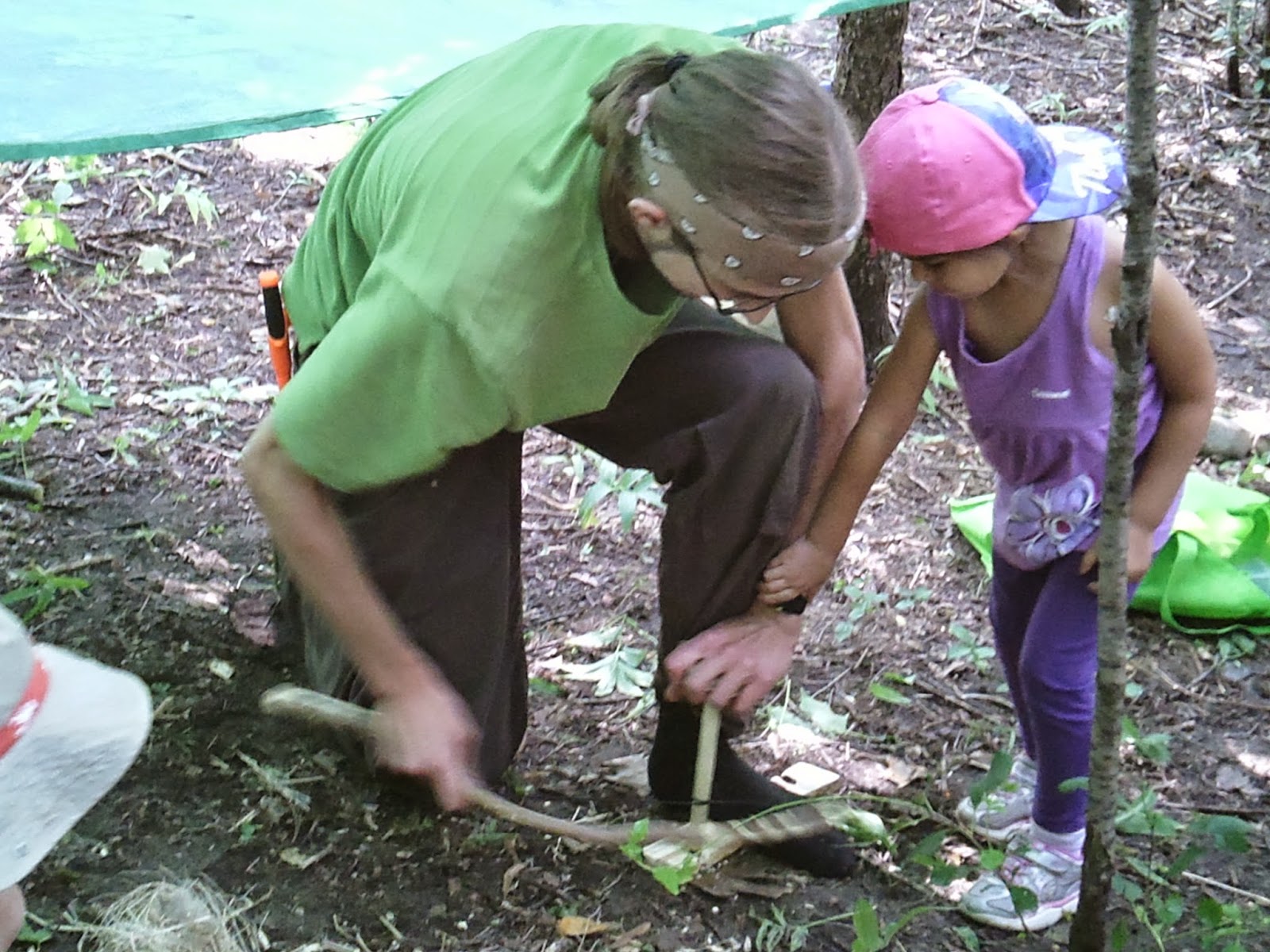
Last Sunday, August 17, seventeen parents and children came out to Waterloo Park to take part in a workshop hosted by Transition Families called "Elements of Forest Living". I had the privilege of leading the workshop, and I'd been looking forward to the opportunity to pull these objects out of my bag of tricks and put them to work in their natural environment.

Waterloo Park is a gem in the midst of our fine city. It has a lake, a splash pad, playing fields, baseball backstops, and most importantly from my view, extensive wooded areas along the quiet banks of Laurel Creek- more than enough forest in which to set up my temporary shelter and spend an afternoon teaching the tools of the trade.


My work as a field leader at KW Forest School, an outdoor after school program for kids, is all about exploring the elements of forest living. During Sunday's workshop we worked with the elements most essential to life anywhere: shelter, water, fire, and food. But there are others. My interest in nature and in naturalist skills has always been rooted in the question: what does life consist of, in its most basic elements? How can learning about these elements teach us to live well?

There's an element of excitement in learning 'survival skills', but to be honest, bare survival doesn't interest me all that much. I've always loved reading stories by Gary Paulsen, Jean Craighead George, and John Tanner, stories about the struggles of individuals to live lives of meaning and purpose in places where natural elements threaten to destroy them. But the best part of those stories is always when the young protagonist returns to human society with a keener and deeper sense of themselves and of their relationships with others.


I believe that taking time to learn what our lives are made of can help us to see more joy in our lives together, even in the moments of discomfort nature might throw our way- a rainy day, a wrong turn on a long hike, or a storm that knocks out the power for days. As a teenager, learning the difference between need and want on a week-long canoe trip helped me to grow into a much happier and more easygoing adult later on.

Our program at KW Forest School doesn't involve week-long trips, or putting knives and saws into the hands of young children, either. But it does teach kids to be confident using tools they can find in their immediate environment, whether it's an interestingly shaped stick, a fibrous plant perfect for making good strong cordage, or a slope ideally suited for use as an impromptu slide. And who knows? They might learn a few useful tricks to pass on to the rest of us. Curious? I know I am.


Transition Families is a new sub-group of Transition KW, focused on bringing together families interested in low-carbon living.
We meet every month to experience Nature by:
- Hiking in local natural areas
- Learning to ID local plants and animals
- Tree Planting
- Cleaning up our environment
But most of all by Having Fun!!

This post has been cross-posted to the blogs of Transition KW and KW Forest School.

Tuesday, 19 August 2014

Why We Need a Forest School in KW


When I think back on the people and places that have been my guiding stars in life, few constellations shine brighter in my memory than summer camp. It's remarkable, the kind of influence that one week out of fifty-two can have on a young person, but what made camp indelible was that we, the campers, took it with us into the rest of the year. My sister and cousins and I would re-tell the counsellors' jokes and re-enact their skits to our endless amusement (and likely our parents' mystified bemusement). We would sing camp songs, again and again. And we began to have a sense that the skills we were being introduced to at camp- canoeing, backpacking, taking pleasure in living roughly and simply- could empower us to change ourselves and our reality outside of camp.


Fast forward a decade or so, and my dream of one day being one of those custodians of cool, a camp counsellor, had become reality, as had all the unmentioned, more properly 'custodial' aspects of the job. (These too had important lessons to teach). Prior to my fifth summer on staff as a nature educator, canoe trip leader, and in-cabin counsellor, a group of parents approached me and a co-worker about their idea for a camp-like outdoor skills program in our city, Kitchener-Waterloo. At our camp the fifth summer is generally a time when staff who have stuck around that long say 'adios' and paddle into the sunset to start other ventures. Perhaps because I was dreading saying goodbye to the life I'd so fervently idealized, perhaps because it sounded like an idea crazy enough to work, I said yes to a three-month pilot program.

That was two years ago. In the intervening time I've had the chance to reflect on the experience in the context of my farewell to camp and my escape from the halls of higher learning. I've had opportunities to seek out training and mentorship that gets me excited about passing on what's been given to me. I've had time to think about the world and my place in it, and I've discovered that being outdoors with kids is where my deepest passion meets the world's deepest need, as a mentor of mine put it. And so, in large part thanks to that initial group of parents, I'm going for it, and I’m extremely pleased to be partnering with Sarah Penner to make KW Forest School a reality this fall.


First off, the need as I see it: something like half of all kids in North America live in cities, where wild spaces are the exception rather than the default. I was lucky to be able to go up to camp once a year and to roam with my dog in the wooded ravine next to our subdivision during the school year. In a city environment, where almost everything a child touches has been designed, marketed, industrially produced, and purchased (yes, even the trees), it's a profound gift for a child to encounter wildness, and the raw, unmoulded materials that fuel creativity.

It's also a bit of a paradox for us to be designing and marketing a service that will deliver those experiences, but for this I'll gladly beg your pardon, because as I see it the other piece of the puzzle is passion. I simply love being in the woods, and my experiences at camp taught me how humbling and awe-inspiring it can be to open a door for a child onto a world they'd never dreamed of before. All the better if that world happens to be their own backyard.


That's part of the point of founding a Forest School in KW. As magical as it can be to go away to camp or even a nearby nature reserve for a little while, our goal with KWFS is to unlock the magic in the places we already inhabit. Nature is everywhere, and she is always teaching. Thus there are no paid teachers at our school; our staff are known as Field Leaders because their main tasks are to keep everyone safe and to make the initial introductions: kid, forest, forest, kid- now go have fun. Oh, and we might have a few magic tricks up our sleeves as well.

Meeting in the park after school once a week with a group of eight kids might not seem like a way to change the world, but is there a larger, subversive purpose behind an inside-out school? Certainly. In a sense, the children in our program will all be visiting scholars, collaborating with us on research into the limits to industrially-produced satisfaction and the possibilities for convivial regeneration. This research will mostly involve playing with sticks, stones, leaves, and snowballs. It may lead to unexpected results; we will keep you, our stakeholders, informed through our monthly potluck 'seminars', when families of Forest School participants will be invited to picnic with us in the park and see what we've been up to. Can you picture it now? If so, you're halfway there- we'll see you in the woods.

This post has been cross-posted to KW Forest School's blog. Check it out!

Tuesday, 12 August 2014

Moro

Map had a cow that he loved very much for the good milk it gave him. The cow had a reputation in the valley where Map lived, a reputation that was well attested to by the fact that he never bragged about her. He just held his head high, in a quiet sort of way, and people would say as he passed, 'there goes Map, who owns a fine cow'.

One time a huge rainstorm climbed over Looktwice Mountain and made itself comfortable down in the valley for most of a day and a night. When Map went out the following morning at milking time, he found his beloved cow standing belly-deep in a puddle of mud. He tried to coax her out, then he tried to lead her out with a halter, then he tried to push her out, but the poor beast only lowed mournfully. Finally Map had to crouch down in the mud puddle and milk her right there, though of course he couldn't get any of that good milk.

Map went to see his friend Hap, who lived up the way and was an accomplished bragger. People would gather in the evenings sometimes just to hear him brag, and the little ones enjoyed his talk as much as the big ones. But when he was done people would go on their way, laughing and shaking their heads, because Hap had a fine big mouth but no cow to his name.

Well, Map went to see his friend, and said, "Hap, my cow is stuck in the mud. Come and help me get her out." So Hap got on his coat and boots and went over to Map's, where the poor beast was still standing belly-deep and contemplating her calamity.

"This looks like a big job," said Hap. "If I were you I'd get some help."

"That's why I got you," said Map.

"No, I mean big help, for a big job," said Hap. "I'm your friend, and I don't want to give you anything less. Let's go across the way and ask Selima."

So they went to see Selima, who lived in a cave halfway up Ware Mountain. Selima had eight hands and knew something about everything, and when they got to the cave opening and knocked, she was making string figures to pass the time.

"Selima," said Hap, "my friend Map has a big job to do and he needs some big help. What would you recommend?"

"The biggest helper I have is called Moro," Selima replied, waving away a fly. "He lives across the way, under that mountain you can see through the cave opening. He usually does what I ask. Just dig under the fireweed and tell him what you want done."

"Great," said Hap. "I knew there'd be an easy way to get the job done."

"Oh, and watch out for his feet," Selima said, and went back to her string figures.

Hap and Map left the cave and started back across the way. "Isn't this great?" said Hap, slapping his friend on the back. "We'll just call up this Moro guy and have your cow back in the barn before you know it."

"I don't know about this," said Map. "What did she mean by 'watch out for his feet'?"

"They probably smell bad," said Hap. "It's no concern of ours. Let's go get our shovels and pay old Moro a visit."

So they did that, and then they went together up the mountain Selima had pointed to, which was called Woebetide Mountain. They stopped partway up and dug where Selima had said to dig, under the fireweed. They hadn't gone very deep before they found an ear, a huge ear, dull pinkish dun like granite. Hap leaned over and said, very carefully, "Hey Moro, wake up!" Nothing happened, so Hap bent closer and shouted, "Hey Moro, wake up!" And Moro did.

He was huge. When he sat up he made half the mountainside fall away, and it cascaded down into the valley, burying three fields and an apple orchard. Even sitting down he towered over them like a grandfather spruce. His skin was dull pinkish dun all over. He had no neck to speak of, just a slab-shaped head that was too big for his ears. He had two little eyes that glowed like cinders, and enormous feet.

"Hey Moro!" called Hap. Moro turned his head slowly and looked down at them. "There's a cow stuck in Map's field down the way a bit- can you get it out for us?"

Moro got up and went down into the valley, and Map and Hap ran along behind him. When he got to Map's pasture he picked up the cow between two fingers (he had four on each hand) and set her down on dryer ground. The poor beast lowed in terror and ran off to the far side of the pasture.

"Great," said Hap, "that was even easier than I'd thought. I wonder what else this guy can do?"

"We should probably thank him and send him home," said Map, who was worried for his cow.

But Hap took Moro to his place and let him sleep in the hayfield. The next day he put Moro to work picking stones, and the day after that he had him heap up the highest drystone wall that valley had ever seen, all the way around Hap's land. Everyone came up the way to see what Hap was up to, and they shook their heads but they didn't laugh.

After that everyone wanted Moro to work for them. Hap bragged and bragged, and they could see that what he said was true. Moro could till fields by running his fingers through the soil. He could split wood with his fingernails. He could mill grain on a windless day. In short, he could do the work of a hundred men, and Hap charged his neighbours accordingly when they asked for Moro's help. In no time at all Hap was the richest man in the valley.

But Moro didn't always do a good job. Sometimes he spun the vanes of a windmill too fast and broke the cogs. Sometimes he turned firewood into wood shavings, or left it as a jumble of half-snapped logs. At other times he simply stopped tilling halfway through a field and wandered off to do something else.

And that wasn't all. Moro's feet really did smell bad, and they were so enormous that he stepped on things by mistake. In his first week working for Hap, Moro flattened two outhouses and a summer kitchen, and by the second week he had demolished someone's house. Hap payed for the buildings to be replaced, but it didn't stop there. Moro knocked down trees that stood in his way, and he trampled fields and gardens into the dirt. He didn't seem to eat, but he drank whole rivers dry.

Soon the neighbours agreed that Moro needed to be reined in. Hap assured them that he would get his helper to repair the damages, but it didn't work. Instead of planting trees or mending fences, Moro started knocking things down for fun. People were frightened, and that made them angry, and they started quarelling amongst themselves about how best to deal with Moro. "It's a big job, but that's why I have a big helper!" Hap kept saying, but nobody listened to his talk any more, because they could see that what he said was foolishness. Moro was ripping up whole forests on the slopes above them and throwing the rubble down into the valley.

After a while Moro got bored and left. He walked over the ruined face of Woebetide Mountain and vanished. Then Map came out of his cellar and went up the way to see his friend Hap.

"Hello Map," said Hap when his friend arrived. "Say, it's been a while since I've been able to find anything to eat around here. Would you give me a bite to eat, or even a cup of your cow's good milk?"

"You know I would," said Map, "but Moro stepped on my cow last week."

That evening a huge rainstorm climbed over Looktwice Mountain and made itself comfortable down in the valley for most of a night and a day. The rain beat down on the wounded earth and washed the soil of the mountain slopes into the bed of the River Way, which rose silted and swollen from its banks and flooded the entire valley. Houses and fences and windmills all were swept away.

When the sky finally cleared, the evening star found Map and Hap halfway up the mountainside, huddled in one of Moro's enormous footprints. As they looked out over the desolate valley, Hap said softly, "That looks like a big job."

And Map said, "It looks like a job for little people."

Tuesday, 5 August 2014

The Message Decoded, Part 4: The Landscape of the Future

This week's reflection is part of an extended commentary on a short story I posted a few weeks back. Read on or catch up, if you're curious- it's your choice. 

This topographical survey of time past, present, and future would not be complete without considering the day-to-day reality of living in the age of peak oil. It can be easy to forget, when we debate the existential implications of petroleum geology in wordy online forums, that there are profound human dimensions to the crisis of this age, though they go by other names. Each time I walk to work down Queen Street, in the opposite direction from the centuries-old Joseph Schneider Haus, I pass small knots of people standing and chatting on the sidewalk outside the downtown job search resource centre. These people are my neighbours, and though I doubt they'd express their circumstances in this way, they are on the leading edge of peak oil.

I've mentioned before that I spent some time in the American South, and that it made a big impact on me. The place I where lived for five months in northwest Georgia is a refugee welcome centre situated on two hundred and fifty acres of field and forest, formerly a cotton plantation. The long-term residents there are a small community of Christians committed to a life of service together, and their ministry focuses on offering newly-arrived refugees a two-month respite on their land, teaching them daily English lessons, and connecting them with energetic young volunteers like myself. (They also grow pecans and sweet potatoes, among other delicious crops. Twenty-first century Georgian agriculture is the inspiration for my optimistic depiction of twenty-third century climate-changed Ontarian agriculture in "The Messengers").

My southern sojourn took place when I was twenty-one and halfway through a degree in Medieval Studies. I was becoming increasingly convinced that academic skill was not the most effective contribution I could make to the future I saw gathering on my horizon, and that higher education was an expensive and depressing sham in any case. Combine this frame of mind with my obsession with what, at that point, I was still calling 'the end of the world', and maybe you can imagine the kinds of things I liked to talk about with whoever would listen.

The conversation that changed my whole outlook came about two thirds of the way through my stay in Georgia. It was a warm spring afternoon, and I was digging a trench to lay a new water line from the well to the garden and goat pasture. Working with me that day was a young man visiting the community from his home on the outskirts of Chicago. He and his wife, both of whom could pass as white and middle-class, had decided a couple of years earlier to move into the poorest part of their city, an all-black neighbourhood with no access to paying jobs or even a grocery store. They had planted a garden and set about meeting their neighbours, with no higher purpose than to live in solidarity with those whom society had abandoned, to 'find the Holy Spirit moving on the margins', as they put it.

As the two of us laboured in the red Georgia mud I began talking about how important I thought it was to get back to the land, since that was what we'd be able to rely on when civilization collapsed. To my surprise, my companion got angry. He talked about his neighbours, about their struggles to survive and how little they had to hope for. He pointed out in no uncertain terms that my fear of the end of the world was itself a form of white middle class privilege, because for the kids in his neighbourhood, for the refugee kids I worked with every day, and for millions of others around the world, civilization had already collapsed. It had already ceased to be of any relevance for its most vulnerable members.

The full weight of that epiphany didn't sink in right away, but as months and years went by I reflected more and more on his reproach. Up until then I'd been prophesying some kind of tipping point, when the price of oil or the global climate or some kind of crisis would make everyone in the world look up and realize what they were living through. But since then I've come to think that although there might be many such moments in the years ahead of us, it's just too easy for those of us with money and social security nets to let the facts slide off us, and to confuse the urgency of 'issues' with the urgent needs of people. It's just too easy not to look up and notice the person standing before us on the street, hat in hand, even as more and more people slip through civilization's cracks into the uncertain world of modern poverty.

Unemployment is growing. How could it be otherwise in a society investing a greater and greater slice of its wealth into extracting an ever thinner wedge of energy to power its basic functions? The price of oil has increased fourfold since 2002 and fivefold from its twentieth century average. In the big picture, this means that fueling a complex civilization is becoming more and more expensive; in the little picture, it means that finding three dollars to catch the bus to the food bank is becoming more and more difficult. Peak oil isn't waiting to swoop in and get us- it's already here, just not evenly distributed. Peak oil, in the final analysis, is a social justice issue.

Another of the communities I visited in the South had a simple slogan to guide its daily practices: reduce the distance. To the degree that we can reduce the distance between ourselves and the poor, physically, socially, economically, spiritually, we will be that much less uncomfortable when we interact with our neighbours on the streets, and that much more prepared for the day when the safety nets fail us too, and we join their number. The moral of the peak oil story, after all, is that we're all going to have to learn to get by with less whether we like it or not. The sooner we prepare ourselves for that descent, the gentler it will be, and the greater our ability to invest in lifestyles and community infrastructure that enable living well with less.

What does that infrastructure look like? Consider the difference between modern poverty, which involves difficult choices between dependence on state welfare or on various black markets, or both, and the twenty-third century poverty I imagined in "The Messengers", which involves producing one's own livelihood with the hard labour of one's own hands. While it's by no means an easy solution, what I want to see is more community support for community-based entrepreneurship. That entrepreneurship doesn't have to involve subsistence farming, but it shouldn't involve high-tech gadgetry, as is the current craze in my city. Complex supply chains and manufacturing processes make the high-tech sector neither truly local nor truly sustainable in a low-energy future.

Local investments in local economies can be as simple as buying handmade jewelry from a fledgling artisan, or paying a couple dollars more for vegetables that came from down the road instead of from around the world. It can be as empowering as funding a young person to live and work in their hometown rather than migrating to the big city or to the oil patch in search of work. I know some fine people currently working in oil or other extractive industries, some of whom are related to me, and it would be wonderful to be able to bring them home to a bustling local economy that valued their time and talents.

Thus my wizardly ambitions have led me further and further into thoughts of economics and business, and I'm quite honestly astounded to have arrived where I am today. But before catching up to my own present, I want to conclude this reflection with another trip into the land of story. That'll be next week.

Tuesday, 29 July 2014

The Message Decoded, Part 3: Descending the Peak

This week's reflection is part of an extended commentary on a short story I posted a few weeks back. Read on or catch up, if you're curious- it's your choice.

Last week’s exploration of what peak oil is and what it means leaves a lot more to be said. While I’d like to cover a wide variety of topics in my writing, I think it’s only fair to be open to those of you who take the time to read these writings about where I'm coming from. My studies of peak oil inform everything I write about, and figure strongly in my thinking about nature and our place in it.

Those of you who are learning about peak oil here for the first time, be warned: if you start thinking these thoughts seriously, they are going to change your life. My life certainly changed when I realized that it was caught up in currents vaster and wilder than any of us have the power to alter, and that I would have to look sharp and act on my own initiative if I wanted to steer a safe course through the rapids. These are hard thoughts at first, but we're all going to have to think them sooner or later, and the sooner we start thinking them together, the easier it will be. Hence this blog.

After initially turning my world upside down, peak oil has become the bedrock of assumptions on which I base my life. I’m no less anchored in my particular worldview now than the other folks I meet strolling through the park are in theirs; it’s just that I’m viewing a world tilting toward a rocky transition into a low-energy future. It’s humorous now to think back to a conversation I had on this subject a year and a half ago with a stranger I met strolling through the park. (That kind of thing just seems to happen to me). He was a concerned environmentalist type too, and was telling me all kinds of things about the electric train that used to run from our city down to Paris, Ontario, the oil pipeline that now runs through North Dumfries Township and under the Grand River south of Cambridge, and the fact that peak oil isn’t real because of fracking.

This last fact rocked me more than I would have expected. You’d think I would have been overjoyed to learn that my future won’t involve long, ragged societal decline punctuated by energy crises, but instead I walked home churning with a renewed sense of existential angst. It just goes to show how powerfully our assumptions and expectations are shaped by our particular worldview- or, to use the more popular jargon, by our particular idio-logy. In my own way I’m as logical an idiot as everyone else; I just happen to think I'm right.

Since that conversation in the park I've done some research into the phenomenon of hydraulic fracturing, or fracking. It's a technologically sophisticated method of extracting natural gas and 'tight oil' that begins by drilling downward about a mile, then sideways, to tap into horizontal layers of shale. The actual fracking procedure consists of injecting water, sand, and secret chemical cocktails into the horizontal well, then detonating charges to fracture the shale and release the tiny bubbles of gas or oil it contains. Certain concerns have been raised about the rationality of drilling into the water table and there blowing up chemical solutions whose formulae are protected by patent law, but let us pass these by for now, because the relevance of the technique to the bigger picture of peak oil is huge.

Richard Heinberg, one of the foremost researchers and commentators in this field, has published a wonderful little book on the fracking boom called Snake Oil: How Fracking's False Promise of Plenty Imperils Our Future. I found it at my local library. The book explores the way that fracking developments in the last decade in North Dakota, East Texas, and Pennsylvania, among other places in the continental US, have been promoted as the end of peak oil and America's ticket to once again becoming a net energy exporter. Heinberg and his colleagues delve into the numbers and flatly refute the claims that the US suddenly has a 100-year supply of natural gas- in all probability we'll witness the implosion of the fracking boom in less than 10.

How that misinformation came about is definitely worth a post of its own, but for the purposes of fitting fracking into the larger story, it's worth pointing out that the boom doesn't contradict the predictions of peak oil. It confirms them. Shale gas and tight oil are not easy to extract; if they were, we would have started the age of petroleum by using them instead of conventional crude, which was pretty much oozing out of the ground in the 1860's. Fracking technology got its start in 1866, when throwing explosives into oil wells was patented, and advanced to commercial application stage in 1949, when two companies independently decided to fill wells with water to pack a better shock wave punch. Shale extraction just needed the right economic conditions (a fourfold increase in the price of oil since 2002) to make it take off. So the current uproar about technology saving the day simply isn't true... it's just another distraction.

What's made fracking a viable enterprise in the last ten years has more to do with the depletion of easier sources of oil, and even more to do with Wall Street's need to pile funds into new, heavily hyped investment vehicles in the wake of the 2008 housing crash. Fracking wells are indeed producing fuel, but the industry as a whole is not turning a profit. Capital investments in the natural gas side of the shale boom alone add up to an impressive $42 billion a year, but in 2012 (the most recent data available as of Snake Oil's publishing in 2013) that gas sold for only $33 billion. This isn't a sign of a superpower reclaiming energy independence. It's a sign of a desperate society burning its roof to heat its home.

The story of fracking helps to illustrate an important aspect of peak oil that's often misunderstood. The 'moment' of the peak isn't when we suddenly run out of oil; it's the moment when the bell curve of oil extraction turns the corner from continually increasing production, to flat production, and later to declining production of ever more difficult-to-extract resources. In other words, the peak comes when we've burned through about half the world's recoverable oil, and it's a period of time rather than a moment. The most widely cited estimate is that we entered that period in 2005, and have since been fumbling into the realization that the way of life we've adjusted to over the last century and a half can only be maintained a little while longer by increasingly costly and desperate measures.

Dramatic moments do happen, though, when nations decide to act on the shifting balance of power caused by depletion. In the fall of 1973 the Organization of the Petroleum Exporting Countries, or OPEC, seized its moment to trump US power by playing the oil card; in the spring of 2014 the Russian Federation saw its chance to trump EU power with a hand involving the vast quantities of natural gas that flow west through Ukraine. That trick is still on the table, and it's anyone's guess which way it will go. But it's a fairly safe guess that gas is going to play a huge role, and that Russia is getting good and ready to call the US' fracking bluff.

That's why I think the American shale boom is the most important thing in the world just now. Its end will likely mark the beginning of major changes in our world, though what those changes will be only a wizard adept can say. These are the vast and wild currents I mentioned earlier, and while it's useful to have a sense of what lies downstream from here, it isn't worth even a moment's worry. All we can do is help those in our canoe fasten their life jackets and choose our course through the rapids well.

As an apprentice wizard of earth, I've chosen my course, and in the coming weeks I plan on sharing some of the projects I'm undertaking to that end. If Laura Erb is able to complete her mission downriver two hundred years hence, with far fewer resources at her disposal than we have today, I'm not afraid to throw my weight into my paddling and hope for the best. Of course, it might help to throw some of the unnecessary cargo overboard- but rather than overextending a good metaphor, I'll leave that discussion for next week.